
Menopause & Hair Loss
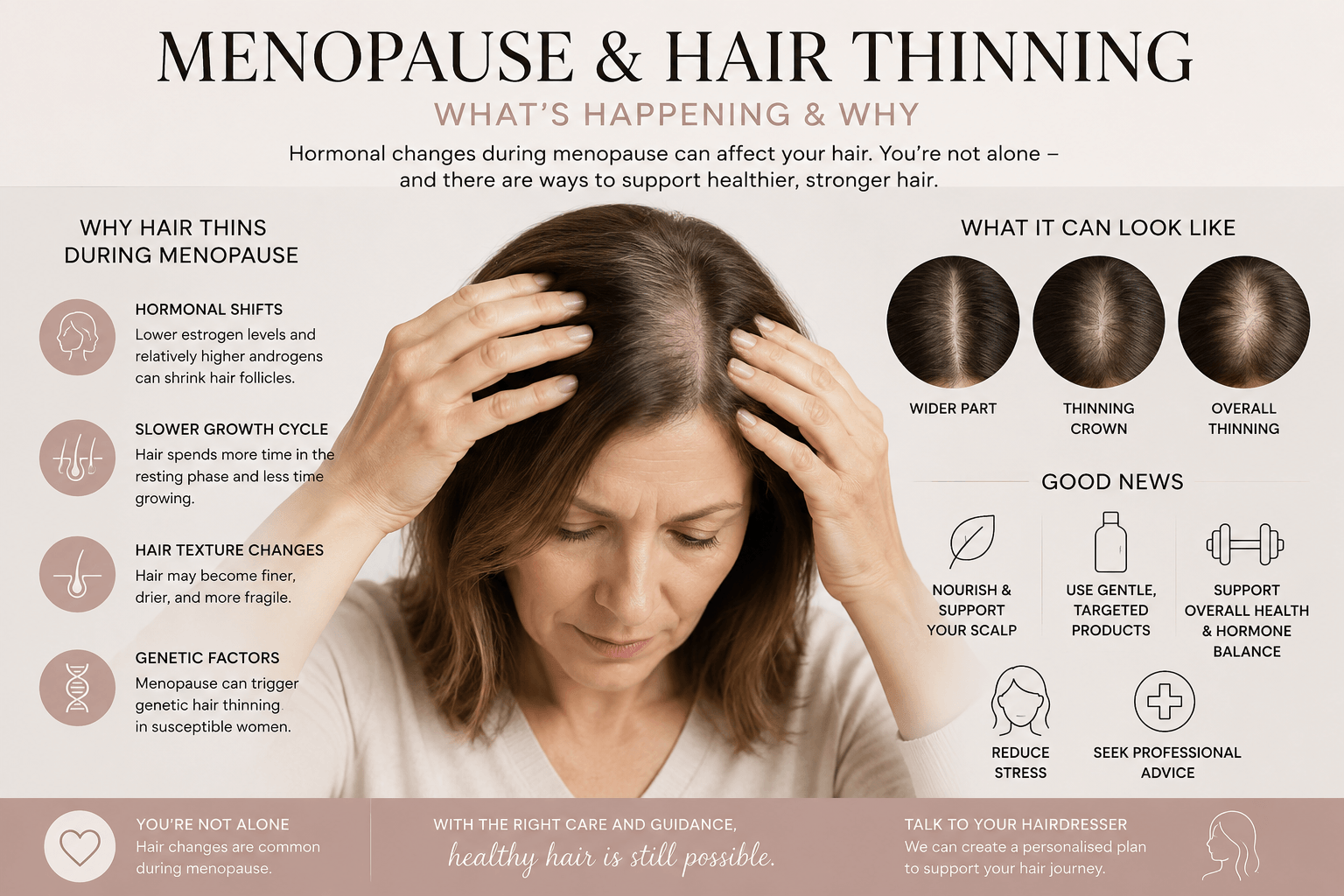
Understanding why your hair changes during Menopause —and what you can do about it.
- Part One — Understanding Your Hair
- Part Two — The Science of Hair Growth
- Part Three — What Changes During Menopause
- Part Four — Evidence-Based Treatments
- Part Five — Your Healthy Hair Journey
Part One — Understanding Your Hair
I don't mind the grey hair,” she said.
"It's the fact that my ponytail is half the size it used to be."
It's a conversation I have almost every week.
For many women, menopause doesn't just change the way they feel—it changes the way their hair behaves. Hair that once felt thick and full may suddenly seem finer. Your fringe doesn't sit the same way. Your part looks wider. Styles that once held their shape seem to fall flat within hours.
These changes often happen so gradually that it's difficult to pinpoint exactly when they began.
If you've found yourself wondering, "Is this normal?", you're certainly not alone.
Hair thinning is one of the most common concerns women experience during perimenopause and menopause. While grey hair is often expected, the gradual loss of density can come as a surprise. In fact, many women tell me it's the thinning—not the grey—that affects their confidence the most.
The reassuring news is that these changes usually aren't happening without reason.
Understanding why your hair is changing is the first step towards making informed decisions about how to care for it.
In this guide, I'll explain what's happening inside your hair follicles, the factors that can contribute to thinning, the treatment options available today and, most importantly, what you can realistically expect from each one.
When Your Hair Doesn't Feel Like Yours Anymore
Very few women sit in my chair and say,
"I'm losing my hair."
Instead, they say things like:
"My hair just doesn't feel the same anymore."
"I can't get the volume I used to."
"My ponytail is so much smaller."
"My scalp seems more noticeable under bright lights."
"My hair feels softer... almost fluffy."
These are often the very first signs of menopausal hair thinning.
The changes are usually subtle.
You may not notice large amounts of hair on your pillow or in the shower. Instead, your hair slowly begins to feel different. It may become flatter, finer or more difficult to style. You might find yourself relying on volumising products or changing your hairstyle to disguise areas that suddenly feel less dense.
Because these changes happen gradually, it's easy to dismiss them as "just getting older."
But there is usually much more happening beneath the surface.
Healthy Hair Tip: Hair thinning doesn't always mean you're losing more hair.
For many women, the number of hairs stays relatively similar. The difference is that each new hair grows back a little finer than the one before it, gradually reducing the overall density of your hair.
Why Does Menopause Affect Hair?
Throughout your reproductive years, oestrogen plays an important role in supporting healthy hair growth.
It helps keep hair in its active growing phase for longer, allowing each strand to grow thicker, stronger and for a greater length of time.
As menopause approaches, oestrogen levels naturally begin to decline.
This changes the environment around the hair follicle.
The growth phase becomes shorter, follicles become less efficient and new hairs often grow back finer than before. At the same time, hair can become drier and more fragile as natural oil production decreases.
For some women these changes are subtle.
For others, they can have a significant impact on the look and feel of their hair.
Myth vs Fact
Myth: Menopause causes every woman to lose her hair.
Fact: Every woman experiences menopause differently. Genetics, hormones, nutrition, stress and overall health all influence how your hair responds. Some women notice very little change, while others experience significant thinning over several years.
Hair Is More Than Just Hair
Hair has always been deeply personal.
It reflects our identity, our confidence and the way we express ourselves.
That's why changes in our hair can feel surprisingly emotional.
After more than a decade of working with women through every stage of life, I've learned that most clients aren't looking for a miracle cure.
They're looking for understanding.
They want to know:
"Why is this happening?"
"Is it normal?"
"Can I do anything about it?"
The answer to all three questions is yes.
Understanding what's happening inside your hair follicles makes the rest of the journey much less overwhelming.
Once you know why your hair is changing, choosing the right treatment becomes much easier.
A Conversation We Have Every Week
One of the biggest misconceptions I hear is:
"I thought thinning hair meant I should be seeing lots of hair falling out."
Not necessarily.
Many women with menopausal hair thinning don't experience dramatic shedding.
Instead, their hair follicles slowly begin producing finer hairs with each new growth cycle.
Imagine replacing a thick rope with a piece of cotton thread.
The rope and the thread are the same length, but one takes up far less space.
Now imagine that happening thousands of times across your scalp.
That's why your ponytail feels smaller, your scalp becomes more visible and your hair loses its natural fullness—even though your hair is still growing.
And that's exactly where we'll begin.
In the next section, we'll explore what's happening inside your hair follicles, why the hair growth cycle changes during menopause and how these changes lead to finer, thinner hair over time.
What's Happening Inside Your Hair Follicles?
One of the most reassuring things to understand about menopausal hair thinning is that your hair isn't simply "giving up."
Your hair follicles are responding to changes happening inside your body.
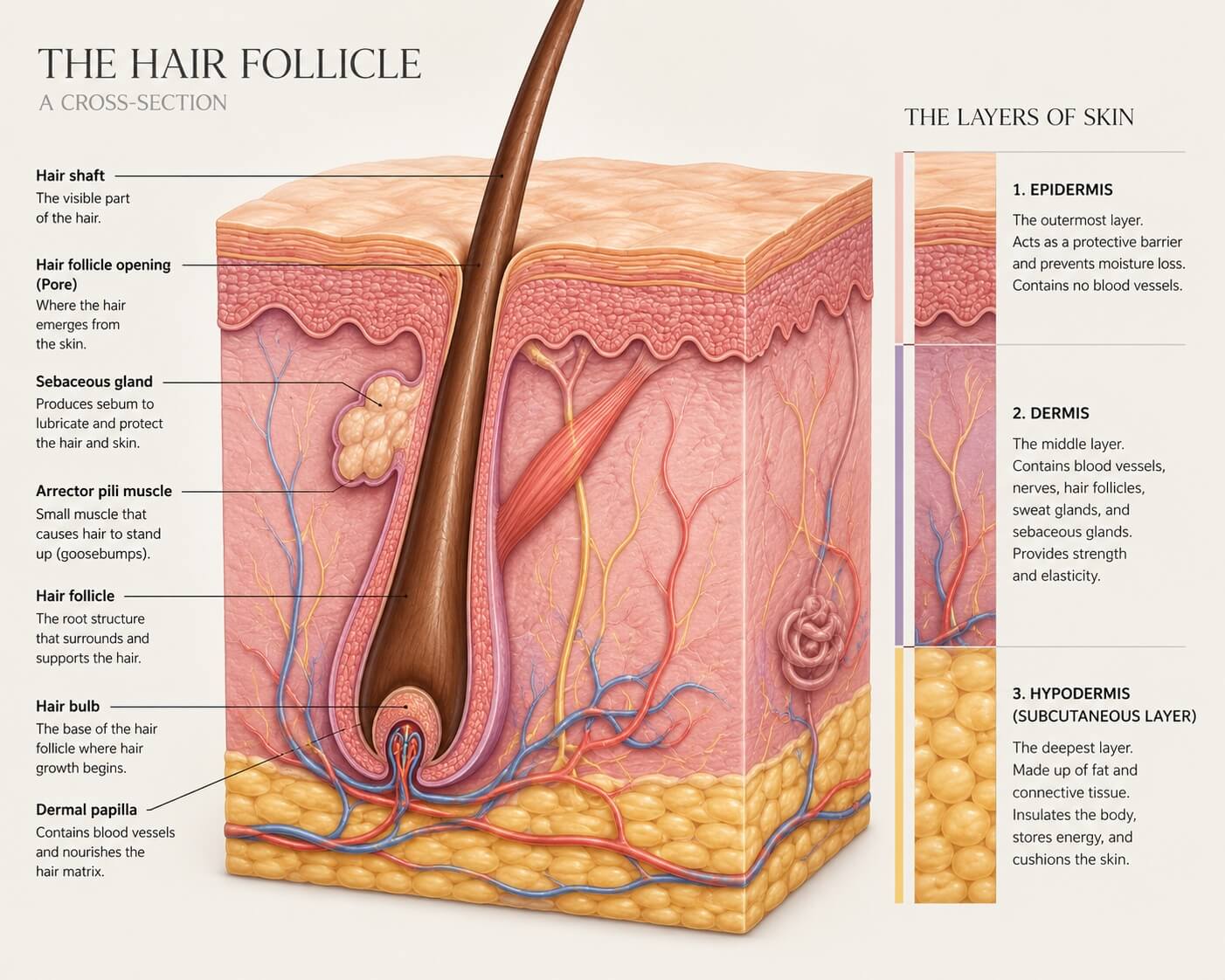
Every hair on your head grows from a tiny structure beneath the surface of your scalp called a hair follicle. Although each follicle is only a few millimetres long, it's one of the most active structures in your body, constantly producing new hair while responding to hormones, nutrition, blood supply and the health of the surrounding scalp.
When everything is working in harmony, your follicles produce strong, healthy hairs that continue growing for several years before naturally shedding and beginning the cycle again.
Menopause doesn't stop this process.
It simply changes how efficiently it works.
Part Two — The Science of Hair Growth
Your Hair Is Always Growing
Many people think of hair as something that grows continuously until it's cut.
In reality, every hair on your scalp is following its own growth cycle.
At any given moment, some hairs are actively growing, some are preparing to rest, while others are naturally shedding to make way for new growth.
This cycle repeats throughout your life and is one of the reasons healthy hair can continue to regenerate for decades.
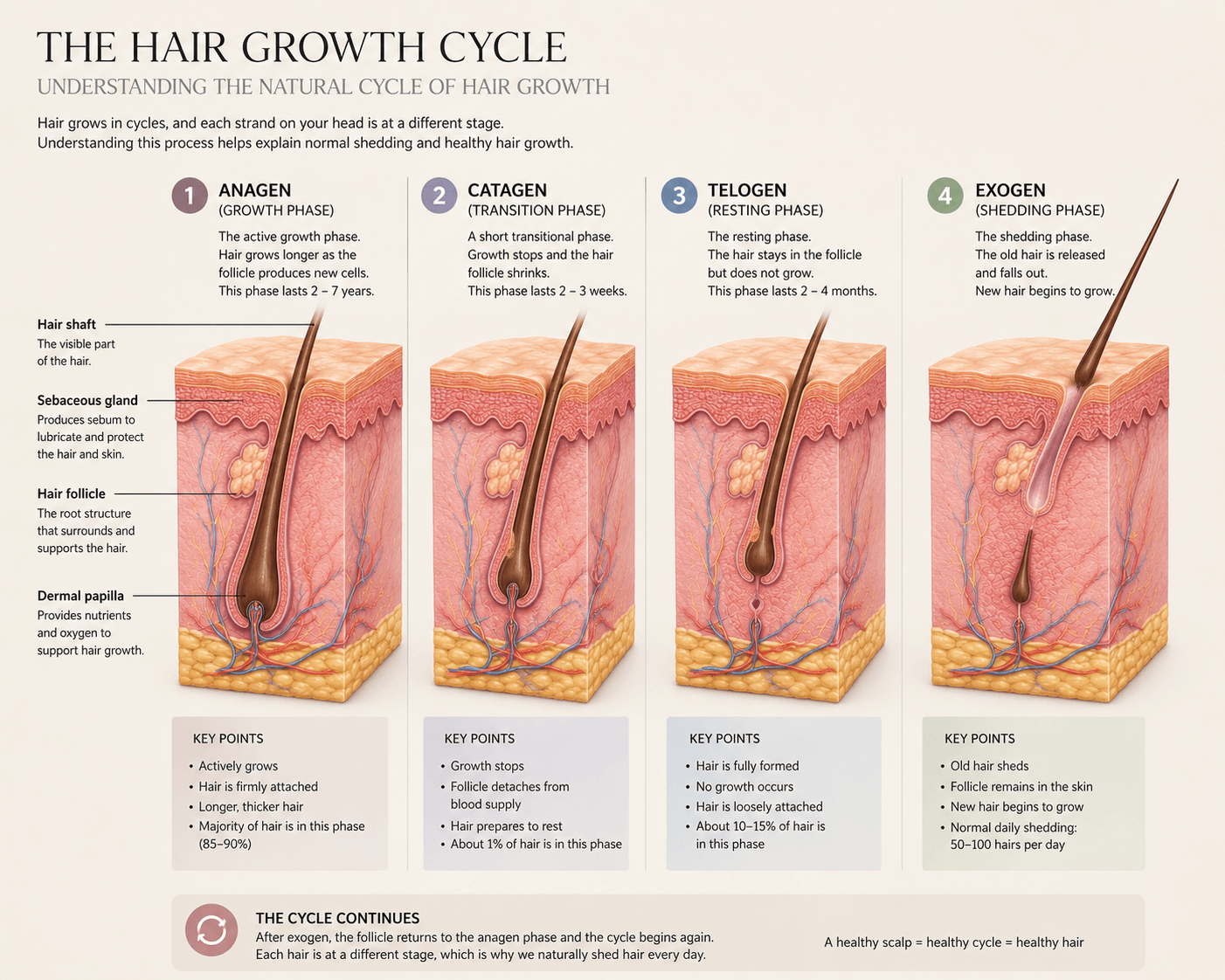
The Hair Growth Cycle
The Growth Phase (Anagen)
This is where your hair spends most of its life.
During the anagen phase, the follicle is actively producing new hair cells, allowing the hair to grow longer and stronger.
For most women, this stage lasts between two and seven years, depending largely on genetics.
Around 85–90% of your hair is usually in this growing phase at any one time.
The longer a hair remains in anagen, the thicker and longer it can become.
The Transition Phase (Catagen)
Once a hair has finished growing, the follicle enters a short transition phase.
Growth slows, the follicle begins to shrink slightly and prepares for a period of rest.
This stage only lasts a few weeks.
The Resting Phase (Telogen)
During telogen, the hair remains in the follicle but is no longer growing.
Eventually it sheds naturally, making room for a new hair to begin growing from the same follicle.
Losing between 50 and 100 hairs each day is considered completely normal.
In fact, shedding is a healthy part of the hair growth cycle.
Myth vs Fact
Myth: Seeing hair in your brush means you're losing your hair.
Fact: Healthy hair sheds every day. The important question isn't whether hair is falling out—it's whether each shed hair is being replaced by another healthy, strong strand.
Part 3: What Changes During Menopause?
As oestrogen levels decline, the rhythm of the hair growth cycle begins to change.
The growth phase gradually becomes shorter, meaning each hair has less time to grow before it enters its resting phase.
At the same time, follicles often take longer before beginning the next cycle.
This means fewer hairs are actively growing at any one time.
But perhaps the biggest change is what happens next.
The replacement hair often grows back slightly finer than the one before it.
At first, the difference is almost impossible to notice.
Over several years, however, thousands of follicles producing slightly finer hairs create a very noticeable reduction in volume.
This is why so many women say,
"My hair just isn't as thick anymore."
Why Your Ponytail Feels Smaller
One of my clients once described it perfectly.
She said,
"It feels like someone has quietly removed a third of my hair without me noticing."
That's exactly what menopausal hair thinning often feels like.
Not because large amounts of hair have disappeared overnight.
But because each individual strand gradually becomes finer.
Imagine replacing every drinking straw in a bundle with a cocktail straw.
You'd still have the same number of straws.
The bundle would simply take up much less space.
Your hair behaves in much the same way.
Healthy Hair Tip: Hair thinning is often a problem of quality, not simply quantity.
Even small reductions in the diameter of each hair can dramatically reduce the overall fullness of your hair.
Understanding Follicle Miniaturisation
The gradual shrinking of the hair follicle is known as follicle miniaturisation, and it's one of the hallmark features of female pattern hair thinning.
Each time the follicle completes a growth cycle, it produces another hair.
When the follicle is healthy, that hair is thick, strong and well pigmented.
As menopause progresses, some follicles become less efficient.
Instead of producing a strong terminal hair, they begin producing hairs that are:
- finer
- softer
- shorter
- lighter in colour
These hairs are often called miniaturised hairs.
This process doesn't happen overnight.
It usually develops gradually over many years, which is why most women struggle to identify exactly when their hair began changing.
Why Do Hair Follicles Become Smaller?
Scientists believe several factors contribute to follicle miniaturisation during menopause.
These include:
- Declining oestrogen levels.
- Increased sensitivity to androgens, including DHT.
- Oxidative stress within the follicle.
- Low-grade inflammation.
- Cellular ageing.
- Changes in the scalp environment.
Rather than one single cause, it's usually several biological changes happening together.
This is why no single treatment works for every woman.
A Conversation We Have Every Week
"Can my hair get thick again?"
It's one of the first questions many women ask.
The honest answer is:
Sometimes—but it depends on the condition of the follicle.
If the follicle is still healthy and active, there is often an opportunity to support stronger, healthier hair growth.
If it has been producing progressively finer hairs for many years, our focus may shift towards slowing further miniaturisation, preserving the healthy follicles that remain and improving the overall quality of the hair.
That's why seeking advice early can make such a difference.
Can Miniaturisation Be Reversed?
This is one of the most common questions I hear.
The answer isn't simply yes or no.
Some follicles respond extremely well to treatment and begin producing thicker, healthier hairs over time.
Others may not return to their previous size, but treatment can often help maintain the hair you have, slow further thinning, and improve the overall quality of new growth.
The key is recognising changes early and choosing an approach that's appropriate for your individual circumstances.
Did You Know?
Hair grows at an average rate of around one centimetre each month.
Because of this, even the most effective treatments require patience. Most women won't notice visible improvements for at least three to six months, and continued improvement often occurs over 12 months or longer.
By now, you can probably see why there's no single explanation for menopausal hair thinning.
Hormones are a major part of the story—but they're not the whole story.
Iron deficiency, thyroid conditions, vitamin deficiencies, stress, illness and even certain medications can all influence how your hair grows.
Before choosing a treatment, it's important to understand whether something else could also be contributing to the changes you're seeing.
Could It Be Something Else?
One of the most important things to remember is that not every case of hair thinning is caused by menopause.
While hormonal changes are one of the most common reasons women notice a reduction in hair density during their forties and fifties, they're rarely the only factor.
Hair is remarkably responsive to what's happening inside your body.
Changes in nutrition, stress, illness, medication and overall health can all influence the way your hair grows.
That's why understanding the cause of your hair thinning is just as important as choosing the right treatment.
Hair Is Often One of the First Places We Notice Change
Your body is incredibly clever.
When it's under stress or lacking important nutrients, it naturally prioritises essential organs like your heart, brain and muscles.
Hair isn't essential for survival.
So when resources become limited, your hair follicles are often one of the first places where you notice the effects.
Sometimes that's slower growth.
Sometimes it's increased shedding.
Sometimes it's simply that your hair feels finer than it used to.
Healthy Hair Tip: Think of your hair as an early warning system.
Changes in your hair can sometimes be your body's way of telling you that something else needs attention.
Iron Deficiency
Iron is one of the most common nutritional deficiencies we see associated with hair thinning.
Every hair follicle relies on oxygen and energy to produce healthy new hair. Iron plays an important role in delivering that oxygen throughout the body.
When iron stores become low, the follicle may not function as efficiently.
The result can be:
- Increased shedding.
- Slower growth.
- Finer hair.
- Reduced density over time.
Many women don't realise their iron levels have gradually declined until a blood test reveals the problem.
You may also notice:
- Feeling unusually tired.
- Shortness of breath.
- Brittle nails.
- Feeling cold more often.
- Difficulty concentrating.
If iron deficiency is suspected, your GP can arrange a simple blood test and recommend the most appropriate treatment.
Myth vs Fact
Myth: Taking iron supplements will make your hair grow faster.
Fact: Iron only helps if you're actually deficient. Taking iron when your levels are already normal won't improve hair growth and can be harmful. Always speak with your GP before starting supplements.
Vitamin D
Vitamin D is well known for supporting healthy bones, but it also plays an important role in normal hair follicle function.
Low vitamin D levels have been associated with several forms of hair loss, and deficiency is surprisingly common—even here in sunny Queensland.
Correcting a deficiency isn't a miracle cure for menopausal hair thinning, but it helps create the healthiest possible environment for normal hair growth.
Think of it as one piece of a much larger puzzle.
Thyroid Health
Your thyroid is a small gland in your neck with a very big job.
It helps regulate your metabolism, energy levels and many of the body's normal functions—including hair growth.
Both an underactive thyroid and an overactive thyroid can contribute to diffuse hair thinning.
Unlike hormonal hair thinning, thyroid-related changes are often accompanied by other symptoms, including:
- Fatigue.
- Weight changes.
- Feeling unusually hot or cold.
- Dry skin.
- Changes in mood.
- Changes in energy levels.
If you're experiencing several of these symptoms alongside hair thinning, it's worth discussing thyroid testing with your GP.
Stress
Stress doesn't just affect your mind.
It affects your hair too.
Significant emotional stress, major surgery, illness, rapid weight loss or even a high fever can trigger a type of temporary hair shedding called telogen effluvium.
This often catches people by surprise because the shedding doesn't begin immediately.
Instead, it usually appears two to three months after the stressful event.
That's why it's sometimes difficult to connect the two.
Did You Know?
If you've experienced surgery, COVID, significant emotional stress or rapid weight loss in the past few months, it may explain why your hair has suddenly started shedding now—not when the event actually happened.
The reassuring news is that telogen effluvium is usually temporary.
Once the underlying cause has resolved, healthy hair growth often resumes naturally, although it can take several months before you notice improvement.
Nutrition
Healthy hair is built from protein.
Without enough protein, vitamins and minerals, your follicles simply don't have the building blocks they need to produce healthy hair.
Rather than focusing on expensive "hair vitamins," I usually encourage clients to look at their overall nutrition first.
A balanced diet rich in:
- Lean protein.
- Iron-rich foods.
- Healthy fats.
- Zinc.
- Vitamin B12.
- Vitamin D.
will almost always do more for long-term hair health than chasing the latest supplement trend.
A Conversation We Have Every Week
"I've bought so many hair supplements... but nothing seems to work."
It's understandable.
The hair loss market is full of products promising thicker hair in just a few weeks.
But healthy hair doesn't come from one miracle ingredient.
It comes from giving your follicles everything they need to function well.
Sometimes that's improving nutrition.
Sometimes it's addressing a hormone imbalance.
Sometimes it's improving scalp health.
Often, it's a combination of several things.
Medications and Health Conditions
Certain medications can also affect the hair growth cycle.
These include some:
- Blood pressure medications.
- Antidepressants.
- Blood thinners.
- Cholesterol medications.
- Weight-loss medications.
This doesn't mean you should stop taking them.
Far from it.
If you think a medication may be affecting your hair, it's important to discuss your concerns with the doctor who prescribed it. They can advise whether an alternative treatment is appropriate or whether further investigation is needed.
When Should You See Your GP?
Gradual thinning during menopause is common.
However, there are times when medical assessment is important.
I always recommend speaking with your GP if you notice:
- Sudden or excessive hair shedding.
- Bald patches.
- Pain, burning or itching on the scalp.
- Significant redness or scaling.
- Rapid changes over a few weeks.
- Hair thinning accompanied by fatigue, weight changes or other health concerns.
Your GP may recommend blood tests to assess factors such as:
Iron stores.
Vitamin D.
Vitamin B12.
Thyroid function.
These tests help identify whether something else may be contributing to your hair thinning.
The Right Diagnosis Comes Before the Right Treatment
One of the biggest mistakes I see is women spending hundreds—or even thousands—of dollars on products before understanding why their hair is changing.
Imagine trying to fix a warning light in your car by changing the tyres.
You might spend a lot of money, but if you're treating the wrong problem, nothing really improves.
Hair is no different.
The most successful treatment plans begin with understanding the cause.
For some women, menopause is the main driver.
For others, iron deficiency, thyroid changes or stress may be contributing just as much.
Once you understand what's happening, choosing the right treatment becomes much clearer.
And that's exactly where we'll go next.
Because while there isn't a miracle cure for hair thinning, there are treatments supported by good scientific evidence—and understanding how they work will help you choose the approach that's right for you.
Part Four — Evidence-Based Treatments
Understanding Your Treatment Options.
By the time many women begin researching hair thinning, they've often already tried something.
A shampoo that promised thicker hair.
A vitamin recommended on social media.
A serum with impressive before-and-after photos.
Unfortunately, the world of hair loss can be confusing.
There are countless products claiming to regrow hair, but they don't all work in the same way—and not all of them are supported by scientific evidence.
One of the most important things to understand is this:
There isn't a single treatment that's right for everyone.
The best treatment depends on why your hair is thinning, how advanced the changes are and what you're hoping to achieve.
Some treatments are designed to stimulate hair growth.
Others improve the health of the scalp.
Some help preserve the follicles you already have.
And some work best when combined with other approaches.
The goal isn't to find the "best" treatment.
It's to find the treatment that's best for you.
A Simple Comparison
Before we look at each treatment in more detail, here's a quick overview.
Treatment Comparison at a Glance
|
Treatement |
How it works |
Best suited for |
Ongoing use required? |
|
Minoxodil |
Stimulates hair follicles and helps extend the hair growth phase. |
Female pattern hair thinning and follicle miniaturisation. |
Yes |
|
Nioxin |
Cleanses the scalp and improves the appearance of fuller hair. |
Cosmetic support and scalp care. |
Yes, for continued cosmetic benefits. |
|
La Biosthétique Régénérante |
Supports scalp health, protects follicles from oxidative stress and encourages a healthier follicular environment. |
Early hair thinning and maintaining healthy follicles. |
Recommended as part of an ongoing hair care routine. |
|
Calecim |
Uses regenerative proteins and growth factors to support follicle repair and communication. |
Hair thinning where follicles are still active. |
Usually completed as a treatment course with maintenance if required. |
Although these treatments all aim to support healthier hair, they work in very different ways.
Minoxidil
If you've researched hair thinning, you've almost certainly come across Minoxidil.
It's one of the most extensively researched treatments for female pattern hair loss and remains the gold standard topical medication recommended by many doctors and dermatologists.
Originally developed as a blood pressure medication, researchers noticed an interesting side effect—patients began growing more hair.
That unexpected discovery led to the topical treatment we know today.
Although scientists are still learning exactly how Minoxidil works, we know it helps stimulate hair follicles and encourages them to remain in the active growth phase for longer.
This gives some follicles the opportunity to produce stronger, thicker hairs over time.
What Results Can You Expect?
This is probably the question I'm asked most often.
The answer is... patience.
Hair grows slowly.
Even when a treatment is working well, visible improvement usually takes three to six months, with continued progress often occurring over the following year.
For some women, the first thing they notice isn't new growth.
It's less shedding.
Others begin to see tiny new hairs appearing around the hairline or parting before improvements in overall density become noticeable.
Healthy Hair Tip: One of the hardest parts of treating hair thinning is waiting.
Hair only grows around one centimetre each month, so meaningful change takes time. Consistency is far more important than expecting quick results.
What About the Initial Shedding?
Some women notice an increase in shedding during the first few weeks after starting Minoxidil.
Understandably, this can be worrying.
In many cases, however, this temporary shedding is a normal part of the process.
Older hairs are released as follicles begin transitioning into a new growth cycle.
Although it can feel unsettling, it doesn't necessarily mean the treatment isn't working.
What Happens If You Stop Using It?
This is something that's often overlooked.
Minoxidil works while you continue using it.
If treatment is stopped, the follicles gradually return to the pattern they would have followed without treatment.
Over several months, any improvement achieved is usually lost, and the hair slowly returns to its previous state.
For this reason, Minoxidil should be viewed as an ongoing treatment rather than a short-term fix.
Myth vs Fact
Myth: Once my hair grows back with Minoxidil, I can stop using it.
Fact: Minoxidil supports the follicle while it's being used. If treatment is stopped, the benefits are usually gradually lost as the hair returns to its natural growth pattern.
Nioxin
Nioxin is sometimes misunderstood.
Many people assume it's a hair regrowth treatment.
It isn't.
Instead, it's a professional hair care system designed to improve the condition of the scalp and help fine hair look and feel fuller.
Think of it this way.
If your garden soil is compacted and unhealthy, planting new flowers becomes much more difficult.
Improving the soil doesn't magically create flowers—but it creates a healthier environment for them to grow.
Your scalp works in much the same way.
Healthy follicles thrive in a healthy scalp environment.
Nioxin helps remove excess oil, product build-up and environmental residue while strengthening the existing hair fibre, making hair feel cleaner, lighter and easier to style.
Many women notice:
- Improved scalp comfort.
- Better volume.
- Hair that feels thicker.
- Easier styling.
While it won't reverse follicle miniaturisation, it can be an excellent foundation for healthy hair care.
A Conversation We Have Every Week
"Should I stop washing my hair because it's thinning?"
It's a question I hear surprisingly often.
The answer is no.
Regular cleansing doesn't cause hair loss.
In fact, a healthy, clean scalp provides the best environment for healthy hair.
The hairs you see in the shower were already ready to shed.
Washing simply helps them leave the scalp.
La Biosthétique Méthode Régénérante
One thing I've learnt over the years is that beautiful hair starts with a healthy scalp.
That's why I love the philosophy behind La Biosthétique Méthode Régénérante.
Rather than trying to force hair to grow, this professional treatment system focuses on improving the environment surrounding the follicle.
Think back to our garden analogy.
Before you can expect healthy plants, you need healthy soil.
The scalp is no different.
When the scalp is healthy and balanced, the follicle has the best possible opportunity to produce healthy hair.
Méthode Régénérante combines botanical extracts with advanced cosmetic science to help protect the follicle from oxidative stress, support normal cellular function and maintain a healthier scalp environment.
- Encapsulated Edelweiss Extract – helps protect the follicle from oxidative stress and is designed to support a longer hair growth (anagen) phase.
- White Lupin Extract – supports cellular metabolism and energy production within the follicle.
- Microalgae Extract – helps improve cellular vitality and supports healthy follicle function.
- Apple Stem Cell Extract – included to help protect the hair follicle stem cell niche, which plays an important role in ongoing hair regeneration.
- Green Tea & Larch Polyphenols – powerful antioxidants that help defend the scalp against environmental stress and premature ageing.
- Red Sage Extract & Niacinamide (Vitamin B3) – help support the scalp's microenvironment and combat glycation, a natural ageing process that can affect the tissues surrounding the follicle.
- Zinc, Trace Minerals & Soybean Proteins – help nourish the scalp and support healthy keratin production for stronger hair fibres.
Rather than forcing hair to grow, the philosophy is to optimise the environment in which the follicle functions. Each ingredient has been selected for its ability to support the scalp and help protect the follicle from the everyday biological changes associated with ageing.
While this approach differs from medications such as minoxidil, it complements many medical treatment plans by supporting healthier scalp function and improving the quality of new hair growth.
Healthy Hair Tip: Healthy hair begins long before it reaches the surface of your scalp.
Supporting the health of the follicle today helps create the best possible environment for healthier hair tomorrow.
Calecim Professional
One of the most exciting developments in hair restoration over recent years has been the use of regenerative science.
Rather than focusing on stimulating the follicle in the same way as traditional medications, regenerative treatments aim to support the natural communication that takes place between cells within the scalp.
Calecim Professional is one example of this approach.
It contains a proprietary blend of proteins and growth factors known as PTT-6®, developed from ethically sourced stem cell technology. Importantly, the treatment does not contain living stem cells. Instead, it contains the naturally occurring proteins and signalling molecules produced by those cells.
Think of these proteins as messengers.
Their role is to help cells communicate more effectively, encouraging an environment that supports healthier follicle function.
These bioactive ingredients include:
- Growth Factors – encourage communication between hair follicle cells and help support the natural hair growth cycle.
- Fibronectin – an important extracellular matrix protein that assists cell attachment and tissue repair.
- Collagen Fragments – help support the structural environment surrounding the follicle.
- Glycoproteins – involved in cellular communication and regeneration.
- Cytokines and Signalling Proteins – help encourage follicle stem cells and dermal papilla cells to function more efficiently.
Rather than replacing cells, Calecim aims to send biological signals that encourage existing follicle cells to repair, regenerate and behave more like younger, healthier tissue.
Its goal is to support:
- Cellular communication
- Tissue repair
- Follicle regeneration
- Improved hair density
- Increased hair thickness
- Better overall hair quality
Research into regenerative hair treatments is continuing to grow, and while they aren't a miracle cure, early studies have shown encouraging results for suitable candidates with active hair follicles.
Who Is Calecim Best Suited For?
Calecim is often recommended as part of a comprehensive hair restoration programme, particularly for clients who are:
- Experiencing early to moderate hair thinning.
- Still have active follicles capable of producing hair.
- Are looking for a non-surgical treatment option.
- Want to combine professional treatments with a broader hair health plan.
Depending on your individual needs, it can be used alongside professional scalp treatments, La Biosthétique Méthode Régénérante and, where appropriate, medically prescribed therapies recommended by your healthcare practitioner.
Like every treatment we've discussed, results vary from person to person.
The healthiest, most responsive follicles generally produce the best outcomes.
What Results Can You Expect?
One of the biggest misconceptions about hair restoration is that results should appear quickly.
Hair simply doesn't work that way.
Even when follicles respond well, they still need time to complete a normal growth cycle before new hair becomes visible.
Most women begin noticing subtle improvements over several months, with continued changes developing over time.
This is why consistency—and realistic expectations—are so important.
Myth vs Fact
Myth: The newest treatment is always the best treatment.
Fact: Not necessarily.
The best treatment is the one that's appropriate for your type of hair thinning, your medical history and your long-term goals. Sometimes that's one treatment. More often, it's a combination of approaches working together.
Why One Treatment Rarely Does Everything
If you've noticed a pattern throughout this guide, it's this:
Every treatment has strengths.
Every treatment also has limitations.
Minoxidil encourages follicles to remain in the growth phase for longer.
Nioxin supports and improves the appearance of fuller hair.
Méthode Régénérante focuses on maintaining a healthier scalp environment.
Calecim supports cellular communication within active follicles.
None of them do everything.
That's why successful treatment plans are rarely built around just one product.
Instead, they're designed around the individual sitting in the chair.
A Conversation We Have Every Week
"Just tell me the best treatment."
I completely understand the question.
But my answer is always the same.
The best treatment depends on what's causing your hair thinning.
If someone has low iron, no shampoo can fix that.
If another woman has early follicle miniaturisation, improving scalp health alone may not be enough.
And if stress is causing increased shedding, addressing the stress itself is just as important as treating the hair.
Hair is never just about hair.
It's about understanding the whole picture.
Part Five — Your Healthy Hair Journey
Creating a Personalised Hair Plan
After more than a decade of being behind the chair, one thing has become very clear.
The women who achieve the best long-term results aren't necessarily the ones using the most expensive products.
They're the women who understand their hair.
They know what's causing the changes.
They have realistic expectations.
And they follow a plan that's designed specifically for them.
That's exactly how we approach hair thinning at Kaitlyn Wagner Hairdressing.
Every consultation begins with a conversation.
We want to understand:
- When did you first notice the changes?
- Has the thinning been gradual or sudden?
- Are you experiencing increased shedding?
- Have there been any recent changes to your health, stress levels or medications?
- What are your goals?
Only then do we begin discussing the most appropriate treatment options.
Healthy Hair Tip: Healthy hair isn't created by using more products.
It's created by using the right products—and only when they're appropriate for your individual needs.
Healthy Hair Comes First
This philosophy influences every service we provide.
Whether we're creating beautiful blonde hair, seamless balayage or helping someone manage menopausal hair thinning, our approach is always the same.
Healthy hair comes first.
When the scalp is healthy and the hair fibre is strong, everything else improves.
Hair reflects more light.
Colour lasts longer.
Styles hold their shape more easily.
Hair simply feels better.
That's why we never see scalp health as something separate from beautiful hair.
To us, they're the same conversation.
Looking Ahead
One of the things I love most about working with women during this stage of life is seeing the relief that comes from understanding what's happening.
For many clients, the consultation itself is reassuring.
Not because they've found a miracle cure.
But because they finally understand that what they're experiencing is common, and that there are practical ways to support healthier hair moving forward.
Knowledge replaces uncertainty.
And confidence begins to return.
Frequently Asked Questions
- Will my hair grow back after menopause?
It depends on what's causing the thinning.
If follicles are still healthy and active, many women can improve the quality and density of their hair with the right combination of treatment and ongoing care.
If thinning has been present for many years, the focus may shift towards preserving existing hair, improving scalp health and slowing further changes.
2. How long will it take to see results?
Hair grows slowly, so patience is essential.
Most women won't notice meaningful improvements for at least three to six months, regardless of the treatment they choose.
Consistency is one of the biggest factors influencing long-term success.
3. Does washing my hair make it fall out?
No.
The hairs you see in the shower were already ready to shed as part of the normal hair growth cycle.
Regular cleansing helps maintain a healthy scalp, which supports healthy hair growth.
4. Is thinning hair inevitable during menopause?
Not at all.
Some women experience very little change, while others notice significant thinning.
Genetics, hormones, nutrition, overall health and lifestyle all play a role.
5. Should I take hair supplements?
Only if they're appropriate for you.
If a nutritional deficiency is contributing to your hair thinning, correcting that deficiency can be beneficial.
However, supplements aren't a substitute for a balanced diet or personalised advice.
6. When should I seek professional advice?
If you've noticed gradual thinning, increased shedding or changes in your hair that concern you, it's worth seeking advice sooner rather than later.
Early intervention often provides more options than waiting until significant thinning has developed.
Final Thoughts
Menopause may change your hair, but it doesn't define you.
The changes you're seeing aren't a sign that you've done something wrong, nor are they something you simply have to accept without understanding. They are a natural response to the hormonal, biological and lifestyle changes that occur during this stage of life.
Healthy hair isn't about turning back the clock or chasing perfection. It's about understanding what's happening beneath the surface, caring for your scalp, supporting your hair with evidence-based treatments where appropriate, and making informed choices that protect its long-term health.
Whether you've only just started noticing that your ponytail feels a little smaller, or you've been navigating hair thinning for several years, know that you're not alone. These conversations take place in our salon every week, and one of the most reassuring things our clients discover is that there are practical, realistic ways to support healthier, stronger-looking hair.
At Kaitlyn Wagner Hairdressing, we believe that every woman deserves honest advice—not unrealistic promises. Our role is to help you understand your hair, recommend treatments that are appropriate for your individual needs, and support you with a personalised approach that prioritises healthy hair at every stage of life.
Because confidence doesn't come from having the hair you had twenty years ago.
It comes from having healthy hair that feels like you today.
OUR PARTNERS


Suburbs we service
New Farm | Newstead | Teneriffe | Brisbane City | Ascot | Hamilton | Pullenvale | Bulimba | Balmoral | Hawthorne | Bowen Hills | Norman park | Morningside | Seven Hills | Woolloongabba | Kelvin Grove | Herston | Fortitude Valley | Kangaroo Point | Spring Hill | St Lucia | Paddington | Red Hill | Bardon | Ashgrove | Wilston | Windsor | Eight Mile Plains | Carina | Manly | South Brisbane | South Bank | FAQ
GET IN TOUCH
7 Lindsay Street, Hawthorne, Brisbane 4171
Phone: 07 3358 1214
OPENING HOURS
| Monday | CLOSED |
| Tuesday | 9:00am - 8:00pm |
| Wednesday | 9:00am - 6:00pm |
| Thursday | 9:00am - 8:00pm |
| Friday | 9:00am - 6:00pm |
| Saturday | 9:00am - 4:00pm |
| Sunday | CLOSED |
